
For many professionals, the idea of public speaking brings an immediate label to mind:
“I’m an introvert.”
It’s a label that often feels final — as if being introverted automatically means you are not meant to stand on a stage, present to executives, or speak confidently in front of a room.
But after more than 16 years of working with corporate leaders and professionals, I have seen a very different reality.
Some of the most powerful speakers I have coached are introverts.
Not because they suddenly became extroverted — but because they learned how to work with their natural strengths instead of against them.
The Myth About Introverts and Public Speaking
The common assumption is that confident speakers must be naturally outgoing, charismatic, and comfortable in the spotlight. In reality, effective communication has far less to do with personality and far more to do with structure, mindset, and preparation.
Introverts often bring powerful strengths to speaking that are frequently overlooked:
These qualities often make introverts highly impactful communicators once they have the right tools.
The Moment the Shift Happens
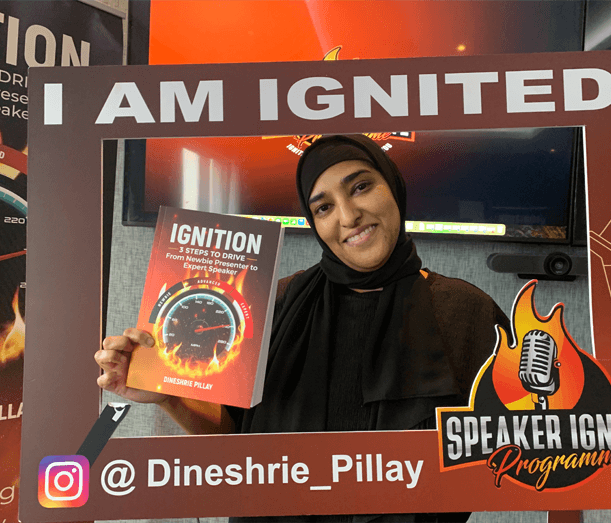
During one of the Speaker Ignite programmes, a delegate initially described herself this way:
“I was very shy, timid, introverted. I wasn’t sure what this programme would entail.”
— Zarina Cassim, Financial Manager
Like many professionals, she believed public speaking simply wasn’t “her thing.”
But something interesting happened during the programme.
As delegates explored the psychology behind speaking confidence, they realised that fear is not something that needs to disappear before speaking.
It simply needs to be understood and managed.
For Zarina, that insight became the turning point.
“The psychological aspect was the turning point for me. I had to embrace my fear and accept it as a privilege.”
Once fear is reframed in this way, confidence begins to grow naturally.


The Surprising Discovery
By the end of the programme, Zarina made a statement that surprised even her.
“I realised I’m not actually an introvert. I just tended to go into my shell in certain circumstances. I’m excited to bring out that extroverted side of me again.”
This moment reveals something important.
Many professionals are not truly limited by introversion — they are limited by lack of exposure, practice, and supportive frameworks for speaking.
When those elements are introduced, the change can be profound.
Speaking Is a Skill, Not a Personality Trait
Public speaking is often treated as a talent reserved for a few confident individuals.
In reality, it is a skill that can be learned and developed like any other professional capability.
With the right structure, professionals learn how to:
And when that happens, something powerful emerges.
People stop seeing themselves as “bad speakers.”
They start seeing themselves as leaders with a voice worth hearing.
Your Voice Deserves a Platform
Whether you are naturally introverted or extroverted, the ability to communicate clearly and confidently is one of the most important leadership skills you can develop.
Because ideas only create impact when they are shared with clarity and conviction.
And your voice may be more powerful than you think.