
Behind the Brain-Friendly Leadership Certification: A Participant Journey Series
Every certification tells a story — not just of learning, but of transformation.
This five-part behind-the-scenes series captures the experiences, insights, and reflections of participants who attended the Brain-Friendly Leadership Certification, a two-day face-to-face train-the-trainer programme built around the i4 Neuroleader™ Model & Methodology.
From curiosity and discovery to action and impact, these stories reveal how neuroscience-based leadership learning comes to life through meaningful conversations about Performance, Collaboration, Innovation, and Agility.
More importantly, this series shares what happens when leaders begin to understand themselves — and their brains — differently.
Part 2 of 5:
The “Aha” Moments Behind Brain-Friendly Leadership Certification
One of the most rewarding aspects of facilitating the Brain-Friendly Leadership Certification is witnessing the moment when participants connect intuition with science.
This connection was exactly what drew me to the methodology in the first place.
For years, I had been searching for tools that could measure leadership development in a meaningful and holistic way. When I encountered the i4 Neuroleader™ Methodology, it provided answers to questions I had been exploring for a long time — particularly the idea that behavioural change can reshape the brain and influence leadership effectiveness.
Participants experienced similar “aha” moments during the certification.
The exploration of the four pillars — Performance, Collaboration, Innovation, and Agility — sparked deep reflection and conversation.
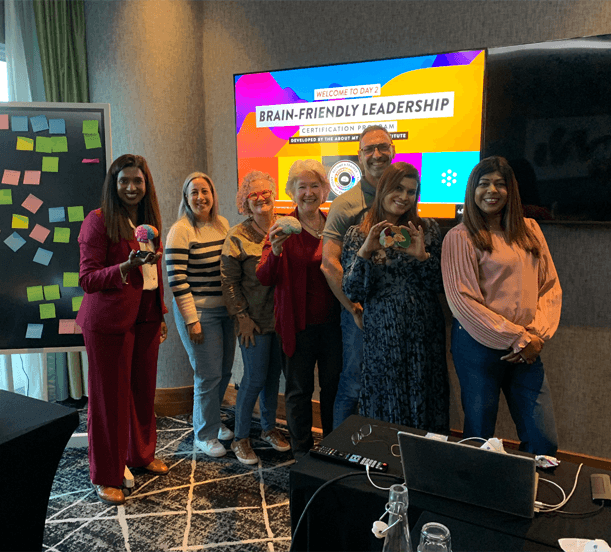
One participant shared:
“Deep down we always know them, but discussing them together is very interesting.”
Brigid appreciated the scientific clarity:
“I knew these practices worked intuitively, but now I understand why.”
Belinda found reassurance in neuroplasticity:
“Your brain can grow and does not have to deteriorate as you grow older.”
Vanessa connected neuroscience to well-being:
“If we apply these practices correctly, the impact can be huge.”

Shira reflected on ethics and daily behaviour:
“Ethics is not just about belief — it’s about how you act in the small things.”
These insights highlight the programme’s unique strength — bridging neuroscience with everyday leadership behaviour.
When leaders understand the brain, leadership becomes more intentional. Decisions become clearer. Habits become purposeful.
The learning stops being abstract and starts becoming personal.